Showing posts with label Turkey. Show all posts

Advanced Block 50 F-16 For Turkish Air Force Unveiled


Turkish Aerospace Industries (TAI) and Lockheed Martin unveiled the first of 30 new Turkish-built F-16s in ceremonies at TAI's facility near Ankara.
Turkish officials at the event included the nation's Minister of National Defense, Vecdi Gonul; Undersecretary for Defense Industries Murad Bayar; Turkish Air Force Chief of Staff Lt. Gen. Abidin Unal; General Manager of the Turkish Armed Forces Foundation Lt. Gen. (Retired) Hayrettin Uzun; and the Chairman of the Board of TAI, Lt. Gen. (Retired) Mehmet Yalcin Kaya.

The U.S. government was represented by Ambassador to Turkey Francis J. Ricciardone, Jr.; Heidi Grant, Deputy Under Secretary of the Air Force for International Affairs; and Maj. Gen. Stanley Clarke III, Chief of the Office of Defense Cooperation.

Posted in , | Leave a comment

Turkey's Aselsan Showcases Advanced Land Surveillance Radar


One of the newest marvels of Turkey’s rapidly growing defence industry as demonstrated at the IDEF 2011 in Istanbul was Aselsan’s ACAR Land Surveillance Radar.

Built on the foundations of battle-proven and widely used (deployed over various terrain profiles in several countries) land radar system ARS-2000, ACAR features the accumulation of the most cutting-edge radar technologies and the latest detection and tracking algorithms of the past decade.

Posted in , | Leave a comment

Turkey Develops Missile For T129 Helicopters


Turkeys first active laser-guided missile, the Cirit, has been receiving attention from other countries as well, Turkish executives have told the Anatolia news agency.

As successful tests continue, foreign armies have started showing interest in the air-to-ground weapon. Turkish officials expect a high volume of foreign sales after the missile meets domestic needs.


Used by Atak helicopters against ground targets, the Cirit performs well on light-armored targets. The missile uses a multipurpose warhead and an electromechanical control propulsion system.

Posted in , | Leave a comment

Chairman Joint Cheif Of Staff Committee In Turkey


Chairman Joint Chiefs of Staff Committee, General Kahlid Shameem Wynne, who is on an official visit to Turkey called on HE Mr Abdullan Gul President of Turkey. Chairman apprised the President about the ongoing efforts of Pakistan in fighting the menace of terrorism. He also conveyed gratitude for support rendered to flood affectees. Turkey shares convergent perception about the emerging global and regional geo-strategic environment and desires to further strengthen the relationship through bilateral exchanges.

Chairman Joint Chiefs of Staff Committee called on Turkish General Staff Headquarters where he was received by Commander of Turkish Armed Forces General Isik Kosaner. A smartly turned out Tri Service guard of honour presented salute. Chairman and Turkish counter part discussed matters of mutual interest and reiterated strengthening of military cooperation between the two countries. Later, he met with Mr Vecdi Gonul Turkish Minister of Defence and discussed issues of bilateral and regional interest.

Posted in , | Leave a comment

Turkish Aerospace Industries (TAI) To Develop New Indigenous Modernization Kits and Mission Computers For F-16s


Turkey’s military aircraft giant Turkish Aerospace Industries (TAI) is set to develop new indigenous modernization kits and mission computers.
Upgrades will be applicable to all the F-16 Block 40 fighters of the Peace Onyx III and Block 50 fighters of the Peace Onyx IV programs, as well as the Block 30s that were acquired earlier. TAI plans to market the upgrades for export to other countries.

Previous news about TAI and Aselsan’s joint attempts to produce indigenous mission computers have been clarified by TAI insiders. Latest reports indicate that the companies have finalized their technical consultations with the MOD and industrial suppliers as of the end of January and the project has been given green light in order to equip Turkey’s vast fleet of F-16s with newly developed indigenous sensors and weapons such as Aselpod navigation and targeting system, various missiles and high-precision munitions produced and/or currently under development in Turkey.
 
Project aims to upgrade all of Turkish Air Force (TurAF) F-16s with indigenous mission computers, software and avionics in order to pave the way for the installation of an Aselsan-developed AESA radar by 2015.
Hardware for the avionics upgrade will be exclusively manufactured by Aselsan, while TAI will tackle the development of millions of lines of highly specialized software. Upgrades will be performed by the same team that performed C-130 modernization and software team mostly consists of experienced engineers who have worked on the Anka UAV development program. Upgraded aircraft will look somewhat similar to existing Peace Onyx exterior configurations, except with specific EW-E/O sensor additions and pylons capable of launching ’Made in Turkey’ guided munitions.

Integration of indigenous systems on aircraft of Lockheed Martin origin is known to be a difficult undertaking. TAI and Aselsan’s take on the project and F-16s “nationalization” at the Block 50 level is expected to offer Turkey a wide window of export and ‘transfer of technology’ (TOT) opportunities thanks to the F-16s widespread popularity around the world. 
Turkey will be able to sell these countries comprehensive modernization packages like the CCIP, individual sensors and weapon systems like targeting pods and missiles, as well as “nationalization” opportunities with direct TOT.
Turkey’s ‘special status’ with the F-16 comes from its existing place among the world’s top three users of the aircraft, previous manufacturing and export experience with the Falcon (to Egypt), as well as Turkey’s long-standing partnership and commitment in the F-35 JSF program.
Some Turkish defence analysts suggest that Turkey’s newfound ability to nationalize the F-16 is simply a means for compensating the country for not being given F-35 source codes, despite the longstanding NATO member’s commitment for an initial batch of over 100 F-35s.

Posted in , | Leave a comment

Turkey’s Air-launched Cruise Missile Almost Ready


Turkey’s Undersecretariat for Defence Industries, has awarded TUBITAK-SAGE a major contract for the development of Turkey’s first medium range high precision cruise missile program.
TUBITAK-SAGE has been working on the new-generation indigenous cruise missile since 2006.

This new crusine missile, name still unknown, is now nearing the end of its development stage and is expected to make its initial debut in Turkey’s largest defence and aerospace fair IDEF 2011, taking place between May 10 and 13.

The cruise missile is designed for air-lunch from Turkey’s upgraded F-4 2020 Terminator aircraft and have a range of over 150 kilometers. Guidance will be provided by GPS and on-board INS, while terminal-stage homing will be accomplished with an advanced Aselsan-built infrared imaging kit for increased precision. 
 
Roketsan is known to be manufacturing the engine assembly in cooperation with TEI, a number of actuators, as well as the warhead of the missile.

Posted in , | Leave a comment

Turkish Army to train the Syrian Army


Syria and Turkey have agreed on training of the Syrian army by the Turkish military.

Anonymous sources contacted the Anatolia news agency and revealed the information that Turkey’s Deputy Chief of General Staff Astan Guner had visited Damascus in December and debated on the training of Syrian army.

During this visit, Guner participated in a Turkey-Syria High-Level Military Meeting, where the rising question about the training of their armies was discussed. In this context, they also discussed the idea of co-operation between their armies and the training of Syrian soldiers by Turkish soldiers.

A lot of people are on the opinion that the Syrian army may assume a western style if trained by the Turkish soldiers. As you know the Syrian army was an inevitable ally of the former Soviet Union.
The Turkish and Syrian armies were at the brink of war during the 1998 as Syria sheltered the terrorist organization PKK. Thankfully, the conflict was dealt with and both countries launched a joint operation against the PKK. The Adana Agreement was signed the same year and it significantly strengthened the bonds between the Turkish and Syrian armies.

Posted in , | Leave a comment

Sino-Turkish Strategic Partnership: Implications of Anatolian Eagle 2010


Turkey’s annual hosting of its "Anatolian Eagle" aerial military exercises at Konya air base in the central Anatolian region of Konya have been central to its efforts to preserve military preparedness and to enhance relations with the air forces of the United States and fellow NATO allies. "Anatolian Eagle" has also encouraged closer relations between Turkey and a range of regional partners—especially Israel—as well as Jordan, Pakistan, and the United Arab Emirates (UAE). Turkey’s guest of honor in the exercises staged from September 20 to October 4, 2010, however, was China. 

While China cooperates with NATO countries and other members of the international community in anti-piracy operations in the waters off the Horn of Africa, its participation in "Anatolian Eagle" marked the first time it engaged in joint air exercises with a NATO member (Hurriyet [Istanbul], October 29, 2010; Xinhua News Agency, January 19, 2009).

The exercises featured U.S.-origin Turkish fighters, namely U.S.-built F-4E Phantoms alongside Russian-built Sukhoi SU-27 Flankers operated by the People’s Liberation Army Air Force (PLAAF) (Asia Sentinel [Hong Kong], October 7, 2010). Rumors circulated that Turkey deployed its advanced U.S.-made F-16 Fighting Falcons during the maneuvers, raising fears in Washington and Brussels that sensitive U.S. and NATO technology would slip into the hands of the Chinese. Turkish officials denied the allegations, however, stating that they took great care to protect sensitive technology, a point confirmed by officials in Washington (Today’s Zaman [Istanbul], October 11, 2010; Reuters, October 9, 2010). The exercises included mock dogfights and other air-based maneuvers. Yet key questions remain regarding the details of important aspects of the exercises. The precise number of Chinese fighters involved in the exercises, for example, is unclear (Aviation Week, September 30, 2010; Asia Sentinel, October 7, 2010).

For all of the attention the presence of the PLAAF in Turkey has received, the greatest implications of China’s participation in "Anatolian Eagle 2010" in the long-run may indeed be understood through the notable absence of two mainstays at "Anatolian Eagle" events: the United States and Israel. The progressive disintegration of Turkish-Israeli relations stemming from Israel’s December 2008 invasion of Gaza and ongoing occupation and siege against the territory—a relationship cultivated over decades and once touted as a strategic axis joining two of the region’s most powerful militaries—prompted Ankara to cancel the international component of "Anatolian Eagle 2009" due to the scheduled participation of Israeli, alongside Turkish, US, and NATO forces (Asia Times [Hong Kong], July 20, 2010; Today’s Zaman, June 8, 2009). Tensions between Turkey and Israel reached a fever pitch following Israel’s May 2010 attack against the MV Mari Marmara, a Turkish aid ship traveling as part of the Gaza Freedom Flotilla, which left eight Turks and one Turkish-American dead (Asia Times, July 20, 2010). Not surprisingly, Turkey did not extend an invitation to Israel to participate in "Anatolian Eagle 2010" or other maneuvers. The United States, according to some Turkish sources, opted out of "Anatolian Eagle 2010" drills to protest Turkey’s exclusion of Israel (Hurriyet, September 1, 2010).

China’s involvement in "Anatolian Eagle 2010" occurred on the heels of its participation in "Peace Mission 2010." A 16-day drill aimed at combating what Beijing refers to as the "three evil forces" of terrorism, separatism, and extremism in the region, "Peace Mission 2010" included forces from Russia, Kazakhstan, Kyrgyzstan, and Tajikistan held under the auspices of the Shanghai Cooperation Organization (SCO)—Uzbekistan opted out of the exercise. One of the highlights of the exercise for China was showcasing the PLA’s rapidly improving expeditionary combat capabilities (See "China’s Growing Clout in the SCO: Peace Mission 2010," China Brief, October 8, 2010). China’s participation in "Anatolian Eagle 2010" demonstrates the PLA’s increasing capability in launching and sustaining long-range combat missions outside of its immediate geographic periphery in East Asia. On their voyage to Turkey, for example, PLAAF planes reportedly made refueling stops in Pakistan and Iran (Hurriyet, October 29, 2010; Press TV [Tehran], October 3, 2010).

There are already signs that "Anatolian Eagle 2010" set a precedent for future joint military exercises, training, and other forms of cooperation between China and Turkey. Beginning on November 8, 2010, the PLA and Turkish special forces participated in a weeklong series of military drills focusing on assault tactics in hilly and mountainous terrain in Turkey (Xinhua News Agency, November 9, 2010). As the PLAAF’s participation in the high-profile "Anatolian Eagle 2010" event represented the first instance of joint air maneuvers between China and a NATO member country, the comparatively low-key ground-based military exercises marked the first time Chinese ground forces operated on NATO soil. According to a statement issued by the Chinese Ministry of National Defense, a special operations unit conducted exercises with Turkish forces at an undisclosed location in Turkey. Although the exact nature and location of the maneuvers have not been disclosed, sources in China claim that the drills focused on joint counterterrorism missions. The same sources also report that the drill was staged in mountainous territory, essentially the type of terrain conducive to harboring insurgent and terrorist movements (South China Morning Post [Hong Kong], November 9, 2010).

The recent developments in Sino-Turkish relations are all the more significant given that it was not too long ago that both countries were embroiled in a spat over the crisis spawned by the violence in Urumqi, the capital of China’s northwestern Xinjiang Autonomous Region (XAR), in July 2009 between ethnic Uighurs—a Turkic and Muslim minority that faces discrimination and repression by the state—and Han Chinese, China’s majority ethnic group. Sharing ethnic, religious, and linguistic ties with the Uighurs, Turkey assumed an advocacy role on behalf of Uighur causes after the fall of the Soviet Union. At one point during the crisis, Turkish Prime Minister Recep Tayyip Erdogan accused China of committing a "near genocide" in Xinjiang (See "Xinjiang Crackdown and Changing Perceptions of China in the Islamic World?," China Brief, August 5, 2009). Ironically, China’s participation in ground maneuvers with Turkish forces in mountainous terrain in Turkey suggests that the PLA is keen to tap the Turkish army’s experience waging counterinsurgency and counterterrorism operations against Kurdish Workers Party (PKK) guerillas to shore up its defense against the "three evil forces" it has identified as threats; Expressions of Uighur identity, activism, and grievances, as defined by China, embody the threats of terrorism, separatism, and extremism.

Trade and Business

If recent trends signal a watershed in relations between China and Turkey, the results of Chinese Premier Wen Jiabao’s three-day official visit to Turkey on October 7-10, 2010, the final stop of Wen's European tour that included stops in Greece, Belgium, and Italy, demonstrate that the most serious tensions over Xinjiang in the aftermath of the Urumqi riots are a thing of the past (Xinhua News Agency, October 7, 2010).

The Chinese premier’s visit with his Turkish counterpart in Ankara proved to be a fruitful one for advancing bilateral commercial ties. Lauding the start of what he described as a new "strategic partnership," China and Turkey declared their goal to increase bilateral trade to $50 billion by 2015 and $100 billion by 2020; the existing volume of bilateral trade is around $17 billion. The current trade balance favors China heavily, however, Turkey is eager to level the playing field by attracting more Chinese investment and promoting itself as a gateway to markets in Europe and the Middle East. Both sides also inked eight agreements regarding investment in the infrastructure, transportation, and telecommunication sectors, and discussed future ventures in the energy, air transport, and tourism industries. The China Railway Construction Corporation (CRSS), for instance, is constructing a high-speed rail link between Ankara and Istanbul. Erdogan said Turkey also intended to build a railway connecting Turkey's largest city, Istanbul, and the Chinese capital, Beijing (Xinhua News Agency, October 8, 2010)

Chinese tourists are also flocking to Turkey in record numbers. While remaining competitors in the textile and electronics sectors, both sides also expressed their commitment to encourage Chinese and Turkish businesses to pursue joint ventures in emerging markets in the Middle East, Africa, and Asia (Financial Times [London], October 8, 2010; People’s Daily, October 9, 2010 Xinhua News Agency, January 19, 2009).

Diplomacy

The talks between Beijing and Ankara also highlighted their shared historical legacies as the modern heirs of the ancient civilizations that intermingled on the Silk Road trade routes and proposed to jointly develop modern transportation links to facilitate contacts between Turkey and China, and the countries in between, in order to revive a new Silk Road (Hurriyet, November 2, 2010). 2011 marks the 40th anniversary of the establishment of bilateral relations between China and Turkey. To honor this milestone, Turkey has declared 2011 the "Year of China"; China was quick to show its gratitude to Turkey by designating 2012 the "Year of Turkey" (Hurriyet, September 2, 2010). The harsh diplomacy that typified Sino-Turkish relations amidst the Xinjiang crisis has given way to compliments, expressions of mutual friendship, and promises of closer and frequent contacts in the future. Wen’s visit to Ankara in October 2010 was the first visit by a Chinese premier to Turkey in eight years; Turkish President Abdullah Gul’s visit to China in 2009 was the first by a Turkish president in 14 years. Chinese President Hu Jintao has already made plans to visit Turkey in 2011; Turkish Prime Minister Erdogan also plans to make his way to China in 2011. The increased frequency of high-level visits committed to by both sides was cemented by the signing of a joint-working committee between the respective foreign ministries, which includes a goal of holding at least one high-level visit in either China or Turkey annually (Hurriyet, November 2, 2010).

The shift in Sino-Turkish diplomacy since the Xinjiang crisis was also on display during a six-day visit by Turkish Foreign Minister Ahmet Davutoglu to China from October 28 to November 4, 2010. In a gesture of China’s importance to Turkey and its interest in forging closer links, Davutoglu announced that Turkey plans to expand its diplomatic presence across China by adding more consulates: "China is almost a continent for us. We want to increase the number of Turkish consulates," stated Davutoglu in Beijing (Hurriyet, November 2 2010). In addition to meeting with his Chinese counterpart Yang Jiechi in Beijing, Davutoglu also toured Kashgar, an ancient center of Uighur culture—the first Turkish foreign minister to do so. Asked about the possibility that Turkey would build a consulate in Urumqi, the provincial capital of Xinjiang, Davutoglu declared, "We are determined to take every step that will bring the Turkish and Chinese peoples closer and open consulates all over China … Uighur Turks, with whom we have close historic and cultural bonds, live in Kashgar and Urumqi. It was important that an atmosphere of calm and peace was achieved in the region after the unrest last year" (Hurriyet, November 2, 2010).

Chinese Vice President Xi Jinping conveyed Beijing’s satisfaction with Ankara’s support to combat "East Turkistan [sic] terrorist forces" in Xinjiang during talks with Davutoglu in Beijing and called for greater Sino-Turkish cooperation in counterterrorism. Davutoglu also reaffirmed Ankara’s support of the "one-China" principle that defines Taiwan as a sovereign part of China. In a veiled remark that likely alluded to the activities of ethnic Uighur activists in Turkey—Turkey is home to a sizeable Uighur diaspora—Davutoglu also reaffirmed Turkey’s commitment to target any activities occurring in Turkey that threaten China’s sovereignty and territorial integrity (New China News Agency, November 1, 2010).

Mapping the Geopolitics

Understanding the backdrop underlying the latest trends in Sino-Turkish relations provides insight into the strategic implications of what appears to be the makings of a burgeoning partnership. China’s participation in "Anatolian Eagle" as a guest of a key NATO member comes amid increasingly vocal criticism of China’s economic policies out of Washington, specifically the manner in which China manages its currency, and heightened tensions between China and its neighbors, including U.S. allies in the region, stemming from territorial disputes in the South China Sea. U.S. arms sales to Taiwan, for instance, remain a major point of contention in Sino-U.S. ties.

The U.S. position on the Iranian nuclear program represents another major dispute clouding relations between the United States and China that may be driving Beijing closer to Ankara. China has demonstrated little serious interest in abandoning one of its most importance sources of oil and gas in the face of growing U.S.-led international pressure for additional sanctions and potentially a military response against Iran. On the question of Iran, Davutoglu declared in Beijing "We discussed Iran’s nuclear program in detail… Our views are very close" (Hurriyet, November 2, 2010). In this regard, Beijing’s efforts to court Ankara are part of a larger strategy to counter Washington’s moves in East Asia and other theaters it sees its interests threatened (See "Shifting Sands in the Gulf: The Iran Calculus in China-Saudi Arabia Relations," China Brief, May 13, 2010).

Finally, the emergence of a new Turkish foreign policy is also shaping the tenor of Sino-Turkish relations today. Although a close ally of the United States and West, Turkey’s ties with the United States, NATO, and Europe have come under increasing strain in recent years over disagreements ranging from the conduct of U.S. foreign policy in the Middle East to the European Union’s (EU) refusal to allow Turkey to join its club. As a result, Turkey appears to have opted for a broader foreign policy that departs from its traditionally Western-oriented focus for a more expansive approach that includes courting forming rivals and new partners such as China (Asia Times, July 20, 2010).

Considering the troubled state of relations following the violence in Xinjiang in 2009, a number of factors bode well for Sino-Turkish relations in 2011 and beyond.

Posted in , | Leave a comment

Problems Persist With F-35 Tuekey To Produce Fighter Its Own Fighter Jets


Turkey is seriously reconsidering the myriad agreements it has signed with the US, as well as its participation in an international consortium for the procurement of new generation fighter jets, due to rising costs and persisting problems originating from the American side.


Turkey is now seeking new ways to sidestep difficulties in the procurement of F-16 fighter planes, which it has been jointly producing with the US since 1987, due to the delayed delivery by the US authorities of some of the plane’s parts and accessories. There have been serious doubts as to whether Turkey’s plan to purchase 100 F-35 fighter planes would ever materialize, as the country is thinking about withdrawing from the consortium following the hike in costs that resulted from other countries leaving from the consortium.


With 240 F-16s, Turkey has the third largest fleet of these fighter jets after the US and Israel. Turkey chose the F-16 to use in its air force in the early 1980s, and Turkish Aerospace Industries (TAİ) was established soon after the decision. Between 1987 and 1995, TAİ assembled 152 planes in the first phase of the F-16 project. The second phase took place between 1995 and 1999, and 80 planes were assembled. Turkey received its first overseas order for F-16 planes in 1993 from the Egyptian air force and assembled 46 planes for them.


Recently TAI upgraded the first of 17 planes for Jordan’s air force within the context of a modernization program. Several Turkey-made planes have also been dispatched to Pakistan.


In total TAİ has assembled 278 F-16s since it first began operations in 1987. During production, 29 planes were produced with no mistakes and three of them were considered “perfect.” Considering that only nine F-16 planes are produced as perfect out of 4,000 fighter jets in the world, Turkey’s success is conspicuous.


Turkey suspended production of the F-16 in 2000, but these fighter jets still remain the backbone of the Turkish armed forces.


Strained ties delayed delivery of plane accessories


As the agreement between the US and Turkey expired in 2000, Turkey has continued to work with Israel in modernizing the F-16s. Turkey has attempted to compensate for several mistakes that occurred while working with the US through several deals with Israel. The fundamental problem was that the US did not hand the F-16s directly to the Turkish Air Forces and it required TAİ-made planes be tested in the US before the eventual delivery to the Turkish Air Forces.


The US had also refused to provide source codes for the software of F-16s to Turkey since the inception of the joint production. Tensions in the relations between the US and Turkey have recently spawned a series of crises in this particular sphere, a possibility which Turkey has overlooked for years.


A senior official at the Turkish Undersecretariat for the Defense Industry (SSM) confided in Today’s Zaman that the US is not willing to provide vital parts of the F-16 planes to Turkey in contrast to agreements the two countries have signed in the past few years.


The same senior official said the US delayed the fulfillment its duties specified in the agreements it signed with Turkey between 1987 and 1995 and that this has caused serious problems in modernization of F-16s.


The official lamented that Turkey is experiencing very serious problems in obtaining parts and accessories for the planes as ties with Israel collapsed, and that he finds it noteworthy to stress that the US administration has made congressional approval a precondition of selling any sort of weaponry and military equipment.


Last October the US expressed concerns that Turkey was using US-made F-16s in the Turkey-China aerial exercises, which took place in the Central Anatolian town of Konya, but Turkey reassured the US administration that no US-made jets were used in the joint drill.


Turkey decided to modernize 165 F-16 planes on Dec. 11, 2009 and several Israeli firms were competing to win the tender, along with Turkey’s TUSAŞ and HAVELSAN. All projects between Turkey and Israel in the areas of military training and cooperation were frozen in mid-June after the lethal May 31 Israeli raid on the Mavi Marmara, which was carrying humanitarian aid to Gaza, leaving left nine civilians dead. The two countries were set to realize a $757 million plane and tank modernization project but this project was also shelved. The Turkish government decided to give the modernization tender to Turkish firms after Turkish-Israeli ties became strained.


A $240 million modernization project was given to Turkish companies, but 30 percent of the plane’s parts will be provided by the US military behemoth Lockheed Martin.


Turkey is also considering its participation in the world’s largest military consortium that is planning to produce 3,000 F-35 fighter jets. Turkey is the ninth country to take part in the production process of the F-35 warplane project. The other countries are the US, the UK, Italy, the Netherlands, Australia, Denmark, Canada and Norway. Turkey is expected to purchase 100 F-35 jets in the next 15 to 20 years. Rising costs pushed several countries to withdraw from the $280 billion project, and the same senior official said Turkey might also consider withdrawing.


The Defense Industry Executive Committee (SSİK), under the aegis of Prime Minister Recep Tayyip Erdoğan, will make its final decision in April. The SSİK is seeking ways to jointly produce some parts of F-35 fighter planes with the American General Electric Co. and the Rolls-Royce Group in Turkey.


Turkey is also deliberating the exchange of its F-16s for F-35s within a reasonable time period. Turkey is expected to pay nearly $11 billion for 100 F-35 fighter jets. Citing rising costs in production, the consortium is asking Turkey for an additional $4 billion for the F-35s, but Turkey is reluctant to pay this amount. As some countries have withdrawn from the project, Turkey will reportedly have to pay up to $25 billion for the project.

Turkey is planning joint warplane production with Gulf countries

Turkey has made a radical shift recently, deciding to produce its first fleet of national fighter jets following crises in F-16 and F-35 projects with the US and Israel.


Turkish authorities decided during a Defense Industry Executive Committee (SSİK) meeting last December to begin production on the first Turkish fighter jets in 2020 in order to meet the needs of the Turkish Armed Forces (TSK). TUSAŞ Engine Industries Inc. (TEİ) and TAİ will be the leading companies that will undertake production of these fighter jets, planning to design and produce plane engines by 2015.


Israel claimed that Turkey will fail to produce these jets as no country in the world would dare to build its own planes without participating in a consortium due to the high costs.


Nationalist Movement Party (MHP) Adana deputy Kürşat Atılgan told Today’s Zaman that no country could produce a fighter jet by itself and for lucrative production, there needs to be at least 400 jets produced. Considering this fact, Turkey had been secretly trying to build a consortium with neighboring and friendly countries. In last month’s SSİK meeting, Gönül also talked about the possibility of joint production of fighter jets with South Korean companies. This issue was raised during Erdoğan’s recent visit to Gulf countries. Turkey thinks it will be easier to produce its own fighter jets with five countries involved in the region.

Posted in , , | Leave a comment

Turkey’s First Indigenous MALE-class Anka UAV Takes To the Skies


Turkey’s first national MALE-class (medium altitude long endurance) unmanned aerial vehicle, dubbed “Anka” after an Anatolian bird, made its maiden flight without much of a publicity just before the New Year’s Day, TRDEFENCE sources reported on Sunday.
Anka is vastly superior to its competition (such as the Heron of Israeli origin) in the same category thanks to its heavier payload capacity, long flight time of 24 hours, higher flight ceiling and state-of-the-art electrooptical instruments that include Aselsan’s next-generation AselFLIR 300T, laser target designator and an indigenously developed synthetic aperture radar (SAR) that can detect, identify and track targets day and night, beyond thick layers of cloud, dust and smoke.
Anka also carries on-board artificial intelligence that enables the aircraft to fly autonomously without the requirement for remote human assistance, find allied airbases in the event of an emergency and land automatically.


An armed version of the aircraft, codenamed Anka-B, is currently under development in Turkish Aerospace Industries (TAI) with further funding from Turkey’s Undersecretariat for Defence Industries, SSM. Reports indicate that Anka-B’s modular weapons architecture will be able to carry Roketsan-developed Cirit laser guided rockets, UMTAS anti-tank missiles and/or other compatible weapon systems depending on the assigned mission.

Anka features low radar observatibility courtesy of its thin profile, carbon composite structures that minimize the usage of highly reflective metal components as well as its aerodynamically efficient design.
The first Anka is expected to be commissioned by TurAF in 2011 with the armed Anka-B following it up in 2013.

Posted in , | Leave a comment

Turkey's Next Generation Anti Tanks Missile

The Medium Range Antitank Missile that will be deployed by Land Forces Units in order to eliminate or stop Armored and Mechanised enemy units is designed by ROKETSAN. The weapon system is developed to be used on a tripod or a land vehicle. It will also provide the user direct and top attack modes, fire-and-forget and fire-and-update firing modes, which can be selected on the weapon system before firing. 

MRAT could also be fired in confined spaces without harming the user.
Inheriting the technology of LRAT, with which it belongs to the same family, MRAT will be equipped with an Imaging Infrared Seeker and will be deployable in day and night and adverse weather conditions, in addition to its capability to update target or hit point with its two-way RF Data Link. In order to increase the hit probability, MRAT also has lock-on after launch capability, and in this mode a mid-course guidance provided by MEMS based Inertial Measurement Unit will be used.

Posted in | Leave a comment

Turkey to Design, Produce its Own Jet Fighter Aircraft

  
ANKARA: Turkey has tossed aside plans to purchase the Eurofighter Typhoon and is pursuing an ambitious endeavor to design and produce its own fighter jet instead. The decision, announced by Turkish Defense Minister Vecdi Gonul, is seen as not only an industrial move, but one aimed at boosting national pride with its “Made in Turkey” fighter.

“The decision we have taken now calls for the production of a totally national and original aircraft,” Gonul told reporters last week after a meeting of the powerful Defense Industry Executive Committee decided to nix plans to purchase 60 of the latest Typhoon jet fighters. “This move by the committee effectively is a decision for making Turkey’s first fighter aircraft,” Gonul said. “The Eurofighter is off Turkey’s agenda.”

According to reports, the new aircraft would replace the aging US-made F-4, which had been upgraded by Israel to last well into the next decade, as well as newer F-16s. The expected roll out date for Turkey’s twin-engine combat jet would reportedly be about 2023.

Ankara has already announced it plans to procure some 100 of the next-generation F-35s Joint Strike Fighter aircraft in a deal worth about $15 billion. The first JSF jets are expected to be delivered around 2015. According to Defense News, however, Turkey would take the approximately 30 F-16 fighters only as a “stopgap” measure.

The decision to fly solo in developing a fighter jet comes as Turkey distances itself from its North Atlantic Treaty Organization partners in Europe and North America, and seeks closer ties with its Middle Eastern neighbors. In November, Turkey disputed NATO plans for a missile shield against a possible Iranian attack and has objected to the alliance sharing information with Israel.
Turkey assembles the F-16s on contract from Lockheed Martin at a Turkish Aerospace Industries (TAI) plant. The government named state-controlled TAI, based on the outskirts of Ankara, as the general coordinator of the new fighter jet project. The Turkish Defense Industry’s Procurement agency SSM has allotted some $20 million for a two-year conceptual design study.

“It’s a large endeavor. I’m skeptical that they would be able to do the project on their own since Turkey didn’t have the adequate technological know-how,” said one aerospace executive intimately involved with the design and production of the Israeli fighter jet Lavi in the 1980s.

“But it’s not just technological know-how. Developing a fighter jet requires billions and billions of dollars. It’s certainly not the same as assembling an aircraft. It takes a very long time to develop the technology and then you need to have the influx of funding to bring it all together,” the executive, who spoke on condition he not be named, told The Media Line.

Turkish industry officials told The Media Line that the government decision didn’t make sense. Turkey was currently so heavily engaged in joint international aircraft design projects such as the F-35 that it wouldn’t be feasible to embark on such a costly and risky venture, the officials said.
While hardly world class, the Turkish defense industry is growing and modernizing. But it remains dependent on foreign technology. TAI has designed the Hurkus, a basic training aircraft, but it has yet to make its maiden flight. It has also rolled out an unmanned aerial vehicle this year called the ANKA.

“Development is very, very expensive. Israel was a small country without a big defense budget. Even when we had the infrastructure we decided to give up on it because it was just too expensive,” the executive said, adding that any development today would likely be more successful with international partners.

Israel eventually scrapped the Lavi — built to be a competitor with the F-16 –under heavy US pressure and from a lack of funds.
Defense Minister Gonul said Turkey might cooperate with South Korea, which was developing the KF-X fighter jet with Indonesia. However, that project has sputtered due to lack of funding.

READ MORE 

Posted in , | Leave a comment

Turkish- Chinese Conducted a Joint Aerial Exercise


Turkish and Chinese militaries recently conducted a joint aerialexercise in central Anatolia, the first such exercise involving the airforces of NATO member Turkey and China.

The joint exercise was part of Turkey’s Anatolian Eagle maneuvers,which have so far been carried out jointly with US, other NATOcountries and Israel. They took place sometime this month in thecentral Anatolian province of Konya, where Anatolian Eagle maneuverstraditionally take place. Turkish F-16s and Chinese SU-27s andRussian-made MIG-29s took part in the joint exercise, staging a mockdogfight in central Anatolian airspace. The exercise comes ahead of aplanned visit by Chinese Prime Minister Wen Jiabao to Turkey nextmonth, which officials say will boost relations to a new level. The twosides are expected to sign several agreements on economic and culturalcooperation during the Chinese prime minister’s visit.

Turkey has recently modified its security policy, removing neighborsfrom a list of countries considered as threats to national security.

Posted in , , | Leave a comment

Turkey looking partner the KF-X Program


The Korea Times reported last Wednesday, September 8, that Turkey hasbeen showing interest in joining the development program of the KF-Xfighter, South Korea The program has won investment from Indonesia,according to the newspaper .

Gen. Choi Cha-kyu, director general of bureal aircraft programs of DAPA(Defense Acquisition Program Administration - Program ManagementDefense Acquisition), during a forum held at the South Korean city ofGyeongju. According to Major General to Turkey runs about 180 F-16s andare considering, seriously, participation in the KF-X program toreplace the old with new fighters, around 2020.


Choi Cha-kyu also said that the KF-X program, which began in 2002but postponed for technical and financial problems, should start againnext year, with the consent of authorities involved in the budget.

Industry sources said that Turkey's participation in the project couldresult in a swap deal: Turkey wants South Korea to consider the T-129helicopter, under development for the Turkish Army, as a candidate forthe AH-purchase program X, heavy attack helicopters.

The KF-X program seeks to develop a site similar game to the latestversions of F-16, circa 2022.South Korea will fund 60% of developmentcosts, estimated at 5 trillion won (approximately $ 4.2 billion, or 7.3billion reais). The rest should be financed by foreign nations ordefense companies, sharing the risks.

Posted in , | 1 Comment

U.S Bypasses Turkey For Withdrawal Of Heavy Weapons And Troops From Iraq

The United States does not intend to pull outheavy equipment and weapons from Iraq through Turkish territory, thoughthe U.S. military has been seeking Turkish permission for thetransportation of some noncombat equipment, Chairman of the U.S. JointChiefs of Staff Mike Mullen said Saturday.

  Though we certainly rely on Turkey's infrastructure to move someequipment in and out of our area of operations, we do not transportweapons through Turkey, nor do we intend to in the future, Mullen saidin the Turkish capital of Ankara.

  Mullen, who made a brief visit to Ankara to meet Turkey's newChief of General Staff Gen. Isik Kosaner, said the United States hasmoved 38,000 pieces of rolling stock and over two million other piecesof equipment out of Iraq safely. He added "certainly none of themilitary equipment, and none of the people have come through Turkey."

  Meanwhile, Mullen said the current agreement between the UnitedStates and Iraq was to withdraw all U.S. troops out of Iraq by the endof 2011.

  "We have withdrawn almost 100,000 troops under the currentagreement, we would do the same over the next 15 or 16 months. Nodecisions have been made in terms of how to do that," he noted.

 On Friday, the Turkish Foreign Ministry spokesmanSelcuk Unal had said the Turkish government, in principle, lookedfavorably on the passage of U.S. weaponless equipment and technicalmaterials.
 Source Here

Posted in , | Leave a comment

Baykar Makina Caldiran Tactical UAV's

Specifications:

Wing Span: 9m
Length: 5.5 m
Cruise Speed: 70 Knots
Endurance: 10 Hours
Communication Range: 150 Km

Features:
- Automatic Taxi
- Automatic Take Off
- Automatic Flight
- Automatic Landing
- Cross Redundant Software & Architecture
- Automatic Return Home & Landing in Case of Lost Comm.
Ground Control Station System (Cross Redundant Architecture)

* Real Time Command / Control
* Multi Display Feature
* Pilot Console Unit
* Copilot Console Unit
* Ground Control Unit
* Ground Data Terminal Unit
* Automatic Tracking Antenna System


Flight Control System:

* Automatic Guidance / Navigation
* INS/GPS Navigation Capability
* Kinematic Model Based Stochastic Filtering Algorithms
* Automatic Landing Feature With Onboard Sensor Fusion Algorithms
* Automatic Fuel Management Balancing Feature
* Redundant Sensor Units (Pitot Static, GPS, IMU etc)
* Fully Automatic Control From Taxi to Landing

Posted in , , | Leave a comment

Baykar Malazgirt Mini Helicopter UAV

Basic Features:
Rotor Span: 1.8 meters
Length: 1.2 meters
Range: 20 Km
Operational Altitude: 3600 ft
Maximum Altitude: 12000 ft
Endurance (Gasoline Engine/ Electric Motor): 90 / 35 Min.
Payload:

* Day Camera System
* Thermal Camera System
* 2 Axis Stabilization System
* Precise Target Coordinate Estimation

Communication System:

* Digital Frequency Hopping Spread Spectrum Telemetry and Telecommand Data Link
* Video Link System

Posted in , , | Leave a comment

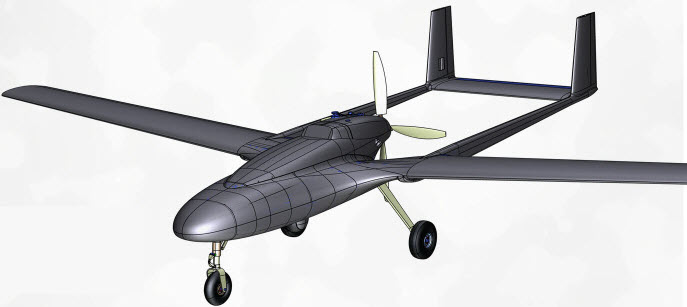
Turkish Aviation Programs-Tiha Male UAV Block-A


Tiha Male UAV Block-A

* Service ceiling: 30,000 ft
* Endurance: 24 hours
* Cruise speed: >75 kts
* LOS communication range: >200 km
The UAV will have a 10m (33ft) all-composite fuselage, detachablelow-mounted wing with a span of 17.3m and a detachable V-tail with aspan of 4.5m.
Maximum take-off weight is 1,500kg (3,300lb) including provision for a 200kg payload and 250kg of fuel.
Initial payload elements will comprise a daylight camera, thermalimager, laser designator, and synthetic-aperture radar with groundmoving-target identification capability. Weaponization will be studiedin the production phase.
The TIHA will have a pusher propeller configuration and a cruise speedof around 75kt (140km/h), service ceiling of 30,000ft and 24h endurance.

Posted in , , | Leave a comment

Turkey uses Israeli-made drones against rebels in Iraq: army

Ankara: The Turkish army has begun using Israeli-made unmanned aircraft to monitor Kurdish rebel movements in neighbouring Iraq, the Anatolia news agency reported Monday, quoting the army chief.
"In the past 10 days, we have started using our Heron systems... the surveillance systems we bought from Israel, in the north of Iraq," General Ilker Basbug said in Canakkale, northwestern Turkey, according to Anatolia.
The drones are being used "at a certain distance in the north ofIraq in coordination with the Americans," Basbug told reporters, addingthat the aircraft were operated "by our own personnel."
There has been media speculation that the drones were idle because Israeli operators left Turkey amid the crisis between the two countries over Israel's May 31 raid on Gaza-bound aid ships, in which nine Turks were killed.
The Turkish army is fighting surging violence by the separatistKurdistan Workers' Party (PKK), which uses rear bases in neighbouringnorthern Iraq as a launching pad for attacks against Turkish targetsacross the border.
Twelve soldiers were killed in PKK attacks over the weekend, most ofthem when rebels assaulted a border unit at the Iraqi frontier earlySaturday.
Basbug played down suggestions that an intelligence failure had led to the attack, which prompted a Turkish air raid on PKK hideouts in Iraq.
The 2005 drone contract was part of an 185-million-dollar project that involved the manufacture of 10 aircraft, surveillance equipment and ground control stations by a joint venture led by Israel Aerospace Industries.
Turkey has received six aircraft and the delivery of the remainingfour are expected in June or July, according to Turkish officials.

Posted in , | Leave a comment
Powered by Blogger.

LinkWithin

Related Posts Plugin for WordPress, Blogger...

Search

Swedish Greys - a WordPress theme from Nordic Themepark. Converted by LiteThemes.com.